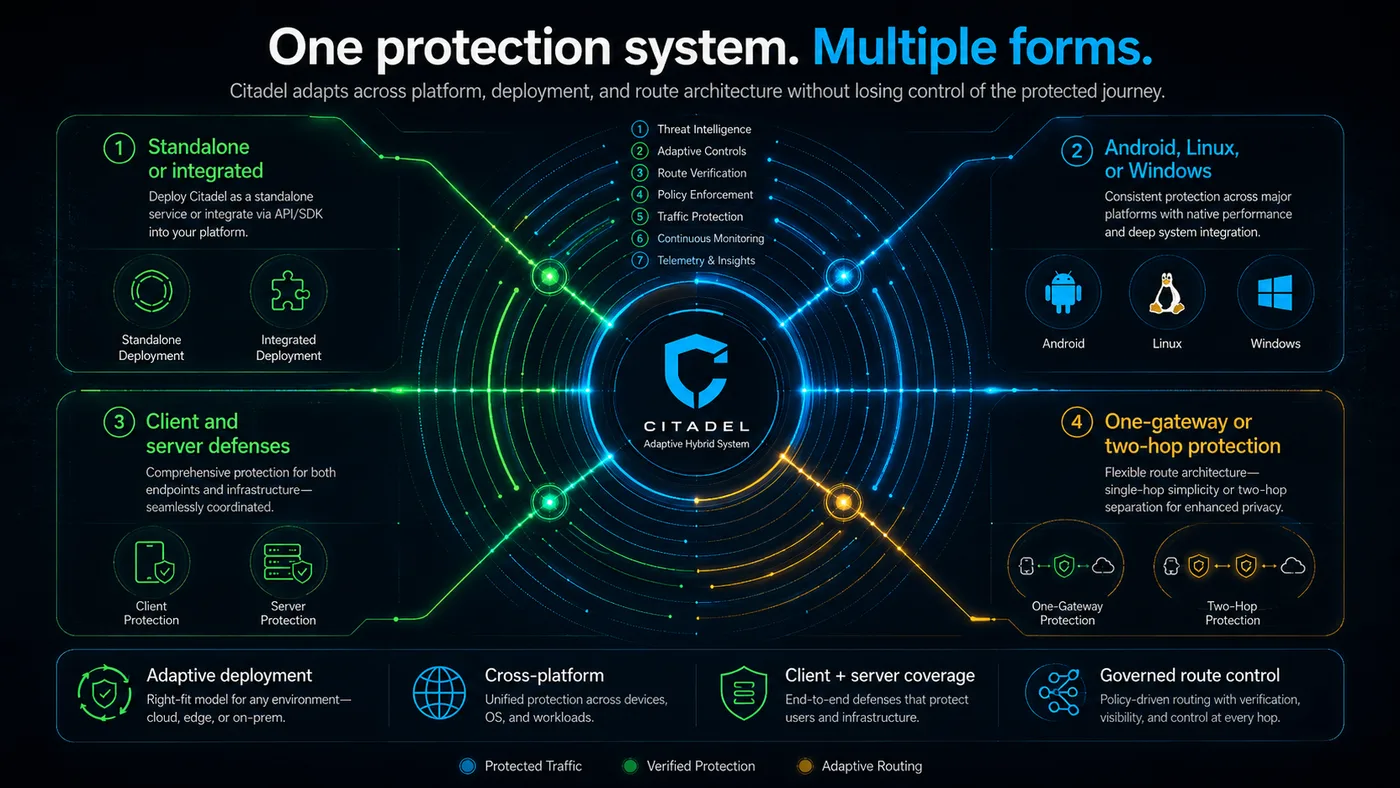
Standalone or integrated
Use Citadel as its own protection client or embed the governed protection boundary inside an application.
The third adaptive hybrid system
Citadel coordinates protected routing, DNS, containment, privacy-safe evidence, endpoint controls, and optional two-hop separation across one governed Internet journey.

One protection fabric
Citadel changes form without changing its responsibility: protect the approved journey, report what is actually happening, and avoid silently interrupting desired traffic.
Use Citadel as its own protection client or embed the governed protection boundary inside an application.
One product family with platform-specific artifacts and qualification states—not one-size-fits-all claims.
Endpoint consent, route truth, gateway enforcement, continuity, and evidence work as separate observable responsibilities.
Start with direct protected egress or select ingress/egress separation when the approved service tier requires it.
The system in one view
The architecture remains available to technical buyers without forcing every customer to decode it before understanding the benefit.
Feature focus
Short, human explanations of how Citadel approaches the protected journey. Each film is a campaign explainer—not a substitute for current operational evidence.
“ADDR resolves destinations deeper in the protected path.”
Maya · Virtual Support Reception“Two hops reduce what one ordinary network position can reconstruct.”
Valeria · Virtual Governance Manager“Device trust should be graded from evidence, not assumed.”
Valeria · Virtual Governance ManagerSelected from the completed Citadel feature-focus campaign. Playback is visitor-controlled; no video autoplays.
Protection that proves itself
Citadel separates the signals that security products too often collapse into one reassuring icon.
The customer requested protection and an approved configuration exists.
The protected network interface is present.
The peer exchange is current—not stale.
Receive and transmit counters prove useful movement.
Resolution follows the approved protected path.
The public exit matches the selected route class.
A customer-facing dashboard is part of the product direction. Any displayed measurements must be identified as real evidence, representative data, or demonstration data.
Current operational evidence
A concise live status is shown here. The complete evidence surface and independent connection tests have their own page.
Current defense posture
Route architecture
Protected transit and public-IP masking through one registered Citadel gateway.
Separates customer-facing ingress from destination-facing egress, reducing what an ordinary single-position observer can reconstruct.
Two-hop separation does not erase identity supplied to a destination, defeat authenticated accounts or cookies, or promise legal untraceability.
Citadel defense sequence
Evidence status is assigned by ring. Citadel’s ten-ring architecture should not be described as wholly deployed, universally qualified, or independently certified.
Protected transit
Protected DNS
Resolution defense
Behavior containment
Minimized evidence
Bounded deception
Screen privacy
Egress defense
Personal DNS privacy
Device and key posture
Citadel products
Production downloads appear only after approval and qualification. Clearly marked laboratory previews remain separate from production releases.
Standalone Citadel Protection client for Android and Android TV. This build is provided for controlled evaluation, not production use.
Client-only bundle for amd64 and arm64 Linux systems. The installer stages protected client files but does not start a service or change routing, DNS, or firewall policy.
Citadel Control Center, activation, diagnostics, guarded updates, and protected uninstall for Windows. RC3 has completed signed in-place installation and live tunnel recovery qualification on the reference system.
Integration showcase
MiraTV demonstrates Citadel protecting a demanding customer application while the application retains ownership of activation, playback, catalog, and session behavior.
Explore MiraTV and the Demo Integration ClientGet Citadel
Managed household plans, Private Server pricing, secure checkout, and licensing inquiries now share one focused billing page.
The claim ledger
A new standard for visible protection
Citadel is moving through controlled qualification. Single and Family plans are available now; platform downloads open only when each artifact's evidence and operating responsibilities are ready.
Get Citadel